🦠 "There's Black Mold in My Apartment" — What That Work Order Actually Means

A tenant submits a work order at 11:40 on a Saturday night. Photo attached: a shower curtain with dark speckling along the bottom hem. Subject line: BLACK MOLD.
The bathroom has a working exhaust fan. You know that because you replaced it fourteen months ago, and because somebody on your team is in that unit every ninety days looking at exactly this kind of thing.
What you're looking at is almost certainly mildew on vinyl, or hard water mineral staining, and it will wipe off with a rag.
You still have to answer it. Within 24 hours. In writing. And you have to answer it as though it might be real, because the one time you don't is the one that ends up in front of a judge.
This is the mold conversation nobody in property management wants to have properly, so most of us handle it by instinct and hope. Here's the version with actual process attached.
🔍 "Black mold" is a phrase, not a category
There is no regulatory category called black mold. There is no federal standard for acceptable indoor mold counts — no OSHA permissible exposure limit, no EPA action level, no NIOSH recommended limit. OSHA says so in its own guidance: there are no federal standards or recommendations for airborne concentrations of mold or mold spores. The CDC is blunter — there are no set standards for what is and isn't an acceptable quantity of any kind of mold in a building.
🗺️ Where states do regulate, they regulate the people
Texas licenses mold assessors and remediators under Chapter 1958 of the Occupations Code, and requires that the firm diagnosing the problem not be the firm selling the fix. Florida, New York and Washington D.C. run comparable regimes. A handful of other states license one side or require registration. Most states, Wisconsin included, license neither. None of them define a species called black mold or set a number you can be over.
🧬 Where the term came from
The term traces back to Stachybotrys chartarum, which got heavy media coverage in the late 90s and became shorthand for "the dangerous kind." Stachybotrys is a real organism. But you cannot identify it by looking at it. Dark growth in a bathroom is far more often Cladosporium, Aspergillus or Penicillium, and confirming Stachybotrys takes lab culture or DNA analysis, not a photo. Color tells you close to nothing.
The CDC's position is the one worth knowing: it isn't necessary to identify the species, because no matter what type of mold is present, it needs to come out. The species is not the question. The moisture is.
✍️ Why this changes how you write back
When a tenant writes "black mold," they are not making a technical claim. They're telling you they saw something dark and they're worried. Treat the words as a signal of concern, not a diagnosis — and do not repeat the phrase back to them in writing. Once "black mold" is in your reply, it's in the record as your characterization too.
Use neutral language. Discoloration. Suspected microbial growth. Moisture intrusion. It sounds like lawyer-speak because it is, and that's the point. Just don't let neutral read as dismissive — the language is there to keep the record clean, not to signal that you aren't taking it seriously.
🚿 What you're actually looking at
There are two categories, and the distinction is the whole job. It's the same line we draw on pest control, and it fails the same way when nobody has written it down in advance.
🧽 Surface growth on a non-porous surface
Shower curtains, grout lines, window tracks, the rubber gasket on a front-load washer, the caulk bead behind a sink. This is a housekeeping and ventilation issue. It wipes off. It comes back if the underlying humidity doesn't change. It is not a habitability defect.
💧 Growth that indicates moisture inside the building
Staining on drywall that spreads or reappears after painting. A musty smell with no visible source. Soft, spongy, or bubbling wall or ceiling surfaces. Warped baseboard or flooring. Discoloration around a window frame in a pattern that follows the framing. Any of these mean water is getting somewhere it shouldn't, and the visible growth is a symptom, not the problem.
The second category is what you respond to. The first is what you educate on.
The diagnostic question is never "is this mold." It's always "where is the water coming from." If you can't answer that, you're not done. EPA's Brief Guide to Mold, Moisture and Your Home is the single best thing to send a tenant who wants to read something, and it's free as a PDF.
🧪 The tenant with a test kit
Someone is going to buy a $22 kit online and mail you a photo of a petri dish with colonies growing in it.
🔬 What the kit actually does
It exposes a settle plate to indoor air for an hour, then you incubate it. Mold spores are present in essentially all indoor air, everywhere, always. The kit will grow something in a hospital operating theatre. A positive result is not information. There's no control sample, no spore count, no comparison to an outdoor baseline, and no chain of custody. It cannot distinguish a normal building from a wet one, which is the only question that matters.
The CDC doesn't recommend mold testing at all, on the grounds that sampling and culturing won't tell you whether anyone will get sick and good sampling is expensive.
💬 What to say instead
Do not argue with the petri dish. You will lose, because you'll look like you're dismissing their health concern over a technicality.
Say this: consumer test kits can't distinguish normal indoor spore levels from a problem, so they don't tell us whether there's an issue in the unit. What tells us is finding the moisture source. Then go find the moisture source.
If the tenant insists on testing, the answer is a certified industrial hygienist doing air sampling with outdoor controls — or, in states that license the role, a licensed mold assessor. Not the kit, and not your maintenance tech with a swab. Know in advance whether you're willing to pay for that and under what circumstances, because deciding in the moment always costs more.
⏱️ The 24-hour rule, and why it's really a 30-minute rule
Every mold-related work order gets acknowledged in writing, in the system, before anything else happens. Not resolved. Acknowledged.
The acknowledgment is three sentences: we received this, here's what happens next, here's when someone will be there. That's it. It costs nothing. It is the single highest-value thing you will do on the entire ticket.
There's a hard deadline underneath this that has nothing to do with liability. EPA's guidance is that wet materials need to be dried within 24 to 48 hours to avoid mold growth starting at all, and Table 1 tells you what to do with each material inside that window. A ticket that sits until Monday morning isn't just a documentation failure. It's a remediation bill you didn't have to have — and the version of that story at scale is 900 residents out of their apartments and a $5.1 million relief package.
The problem is that mold complaints don't arrive at 10am Tuesday. They arrive Friday night, Sunday morning, over holiday weekends, because that's when people are home noticing things. Two things fix this and neither is heroic.
🌙 Someone covering intake outside business hours
This is not a technical role. It's reading the work order, sending the acknowledgment, applying the right tag, and escalating if it hits your urgent tier. It's one of the easiest maintenance functions to staff remotely, and the one with the highest downside if it goes uncovered. Every storm weekend proves it — the calls don't stop because your office is closed.
⚙️ An automation that flags untouched work orders
If a ticket tagged moisture or mold has no activity at hour 12, it should be pinging someone. Most PM platforms will do this natively; if yours won't, a Zapier rule reading the work order feed will.
The gap you're closing isn't skill. It's clock coverage.
🚦 Your triage tier
Mold complaints do not all get the same response time, and you should have decided this in writing before you needed it.
🔴 Urgent — on site within 24 hours
Visible growth on building surfaces: drywall, ceiling, subfloor. Any active water intrusion. Musty odor with no identifiable source. Growth over roughly ten square feet or more. Growth in a unit where a tenant has disclosed a respiratory condition or immunocompromise — treat that as an accommodation trigger, not just a risk one, and document that you did.
🟡 Standard — respond within 48 to 72 hours
Surface growth on non-porous fixtures. Recurring bathroom or window condensation. Tenant reporting general concern with no visible growth.
🟢 Scheduled
Ventilation upgrades, dehumidifier installation, regrading and drainage work, and anything else that addresses the root cause but isn't an emergency. This is the tier that quietly decides how many of the other two you get — grading, gutters and downspouts belong on the spring exterior walk, and ventilation problems are the kind of thing an energy audit surfaces before a tenant does.
Write it down. Put it in your maintenance triage form. When you improvise a response time under pressure, you improvise inconsistently, and inconsistency is what makes a pattern of neglect look like a pattern. If you don't have that form written yet, that's exactly why we built PM Advisor — nobody should be inventing a triage standard at 11:40 on a Saturday.
📞 When you stop and call someone
You handle small surface growth in-house, against a written checklist. You do not handle the following in-house:
- Affected area larger than about ten square feet
- Anything requiring removal of drywall, insulation, or subfloor
- Sewage-contaminated water, ever
- HVAC system contamination
- Any unit where a tenant has made a written health claim
- Anything where you'd be uncomfortable having your remediation photos read aloud in a deposition
📏 Where the ten-square-foot line comes from
It isn't something I made up. EPA's homeowner guidance treats a moldy area under about ten square feet — roughly a three-by-three patch — as something you can handle in-house, and points you above that to Mold Remediation in Schools and Commercial Buildings. That document's Table 2 sets containment and PPE tiers as the affected area grows, and it's worth printing the table and keeping it wherever your maintenance SOPs live. The same guidance flags sewage-contaminated water and suspected HVAC contamination as stop-and-call-a-professional triggers regardless of size.
Be precise about what that number is, though. It's a guidance benchmark, not an enforceable limit, and not a Wisconsin standard. Use it as your internal trigger because it's the number an insurance adjuster, a hygienist, and a plaintiff's expert will all recognize, not because a statute requires it. The same is true of ANSI/IICRC S520, the industry consensus standard for remediation work. It has no statutory force anywhere. It is still the document an opposing expert will hold your job up against.
🤝 Line up the contractor before you need one
Get their insurance certificate on file and know their after-hours number. The middle of a water loss is a bad time to be comparison shopping — do the vendor work when nothing is on fire.
Once a tenant has made a written health claim, the calculus changes entirely. From that point, everything goes through a third party with credentials and documentation, because your own maintenance log stops being sufficient evidence the moment health is on the table.
🎯 The move-out play
Here's the one every experienced manager recognizes.
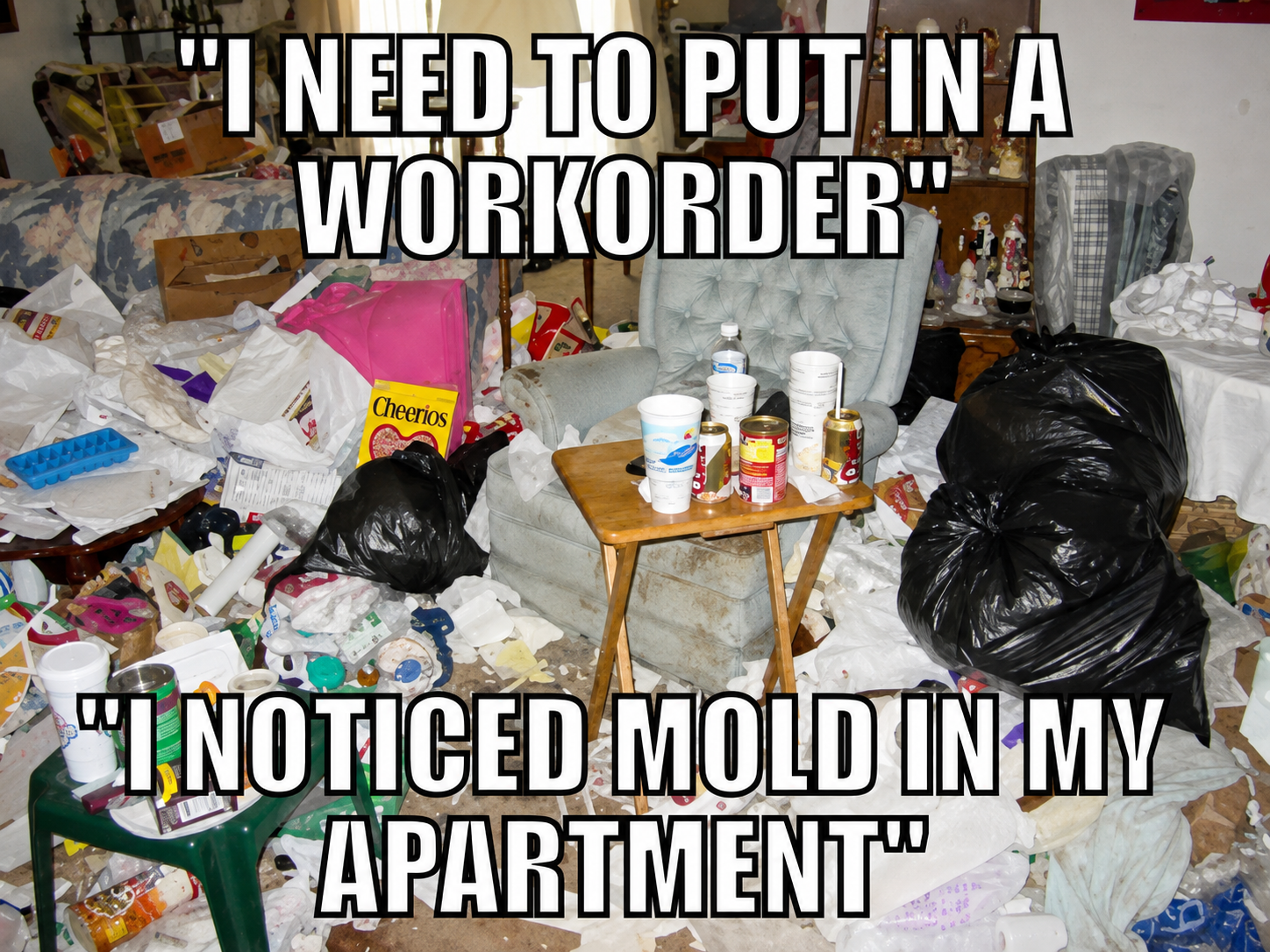
Tenant gives notice they want out early. You quote the lease break fee. Forty-eight hours later, a mold complaint appears, often for a condition they've apparently been living with for months without mentioning it.
Sometimes it's real and they genuinely didn't report it. Sometimes it's a lever. You will not be able to tell which from the work order, and it doesn't matter, because your response is identical either way.
📂 What actually defends you
Not being right. The file:
- Dated, timestamped photos at intake and after remediation
- Moisture meter readings, recorded as numbers, not "looked dry"
- Every communication in writing, in the system — never by text or hallway conversation
- Response timestamps that show you met your own stated SLA
- Move-in condition documentation from the start of tenancy
- Notes written as though a third party will read them, because one might
If you responded within 24 hours, documented the condition, identified the moisture source, remediated it, and confirmed resolution in writing, a habitability claim has nothing to attach to. If the ticket sat unread over a weekend and got closed with "resolved, no issue found," you're negotiating.
Same set of facts. Different file.
✅ The part that's easy to say and hard to do
Answer every single one. Including the ridiculous ones. Especially the ridiculous ones.
The tenant complaining about the shower curtain is not trying to sue you. But the acknowledgment you send them costs thirty seconds and lives permanently in the record as evidence that this is how your company handles moisture complaints. Promptly, in writing, every time.
You cannot build that pattern retroactively. You build it on the tickets that don't matter, so it's already there on the one that does.
🔗 Check Out Our Industry Partners ✅
| Share with your network |
PM Monthly Forecast
Operational insights for property management companies.
Follow Property Manager Assistant:
YouTube •
LinkedIn •
Facebook •
Instagram
© pmadvisor.ai
Need help implementing these new SOPs into your company? Talk to us about Virtual Assistant Services specifically designed for Property Management Companies.
This article is provided for informational purposes only and does not constitute legal advice. Mold licensing, disclosure, and remediation requirements vary by state. Wisconsin has no mold-specific statute; a landlord's obligations arise under the statutory duty to repair and the implied warranty of habitability set out in Wis. Stat. § 704.07. Readers should consult qualified counsel in their own jurisdiction before adopting any policy or procedure described here.


