🦺 Your Workers' Comp Rate Was Set Two Years Ago

Most property managers can quote their management fee to the decimal point. Ask them what their workers' compensation experience modifier is, and there's a long pause.
It's one of the most expensive numbers in a property management company that nobody is actively managing — mostly because of how it's structured. It doesn't arrive as a separate bill you can question. It's buried in your premium, calculated using events that happened years ago. By the time you see the effect, the window to prevent it has already closed.
We rebuild our maintenance charge-out formula against the actual policy audit — the real, all-in cost of putting a technician on a job. Workers' compensation is one of the largest variables in that formula. If you're using a round assumption instead of your audited cost, every labor rate built on top of it is wrong.
That's a story for another month.
What I want to talk about is the number underneath it, because that's the part that quietly costs you money year after year without ever appearing as a line item anyone questions.
🧱 How the number is actually built
Your workers' compensation premium isn't based on one simple rate. It's built in layers.
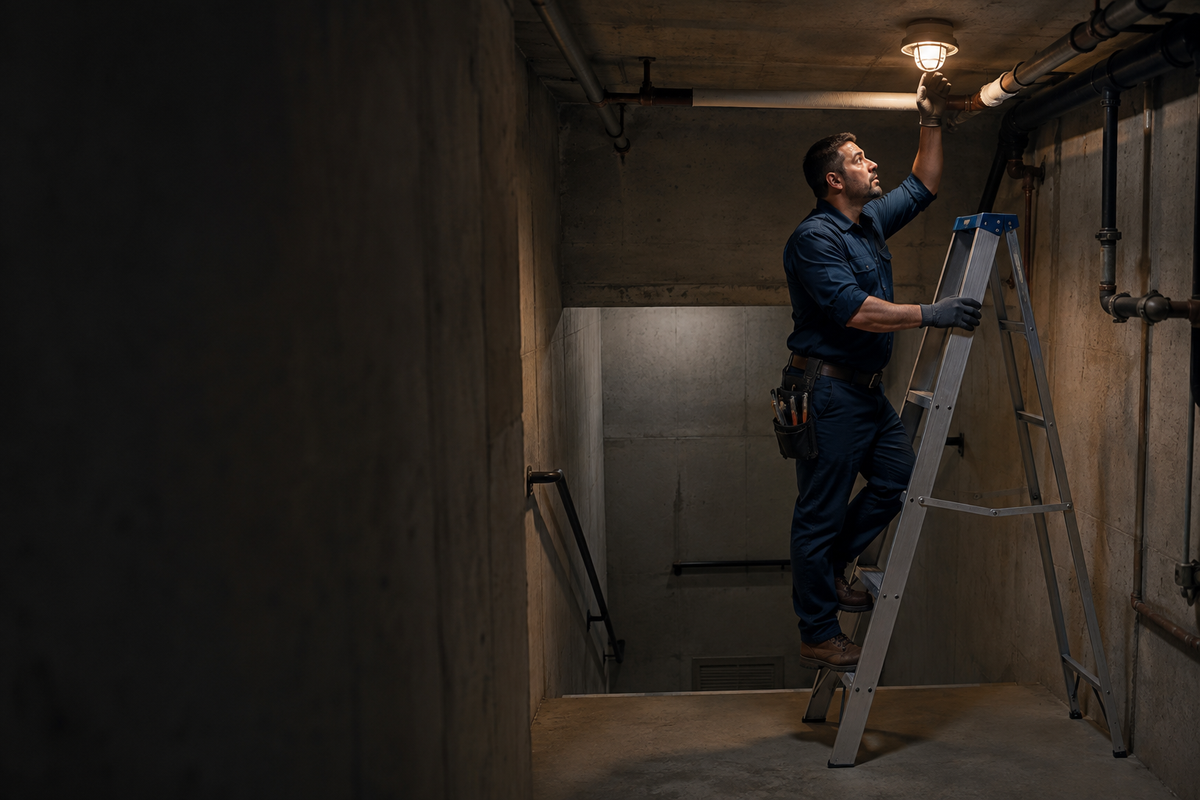
First, payroll is divided among class codes. Your maintenance technicians and office employees are not in the same category, and they are not priced anywhere near the same. Maintenance work carries a materially higher rate per $100 of payroll, because someone working from a ladder in a basement stairwell presents a different level of risk than someone sitting at a desk.
If your payroll records don't properly separate those classifications, you're mispricing labor — and the policy audit is where you find out.
Then the applicable premium is adjusted by your experience modifier, commonly called your "mod."
A mod of 1.0 means your loss experience is in line with what's expected for comparable employers. Below 1.0, you're performing better than expected and you pay less. Above 1.0, your claims history is increasing what you pay.
Ours is above 1.0 right now. Not catastrophically, but enough that the modifier adds thousands of dollars to a single policy year.
That increase isn't coming from the base rate. It's the financial consequence of our claims history — and we're working it down.
⏳ The mechanism that catches people
The modifier is based on a rolling, multi-year period, and it lags.
In Wisconsin, experience modifiers are calculated by the Wisconsin Compensation Rating Bureau, established by statute to administer workers' compensation classifications, rates, and experience rating statewide. Many other states use NCCI, and some operate through their own rating organizations.
The exact mechanics vary, but the underlying principle is the same everywhere: the claims influencing your rate today happened years ago, and the safety improvements you make this quarter won't meaningfully affect your modifier until future renewals.
There is no last-minute fix before renewal. You either started addressing it years ago or you didn't.
If you didn't, today is the earliest possible start on what you'll be paying in 2028.
One more thing worth knowing: in Wisconsin, a business generally must generate enough premium to qualify for experience rating at all. Smaller operations may not have a modifier yet — which is exactly when to establish the right habits, before the number starts following them from one policy year to the next.
🏢 Why "just move maintenance into its own entity" doesn't work
This question comes up constantly, and it's a reasonable instinct.
Spin the maintenance operation into a separate company. Give it its own policy. Walk away from the existing modifier.
The insurance industry thought of that first.
Entities under common ownership or control may be combined for experience-rating purposes. The ownership and operational relationship is what matters — not whether you created a new LLC.
There are legitimate legal, operational, and financial reasons to separate a maintenance division, and we're building one. Escaping an unfavorable modifier isn't one of them, and anyone selling you a new entity solely for that purpose is selling you something.
📋 The boring thing that helps move it
Training — documented, role-specific, and delivered on a schedule — is one of the most controllable places to start.
Be clear on the causation, though. Training doesn't directly lower your modifier. Preventing injuries, reducing the frequency and severity of claims, and managing claims well are what improve your loss history. Good training is what makes those outcomes possible.
We run a semiannual safety program through our carrier's on-demand training platform. Two parts of our process matter as much as the content itself.
It's divided by role. Leadership and management receive one track. Field and maintenance employees receive a completely different one.
A blanket, all-hands video where your bookkeeper sits through ladder safety is a box-check, and everyone watching knows it. People absorb training that reflects the work they actually perform.
Completion is tracked and followed up on by a named person. This is where nearly every safety program I've watched fail has failed, so it's worth explaining exactly how ours works.
✅ How the follow-up actually works
At Prosper, Marie owns it.
She sends the assignment email — not a general announcement, but a clear list showing who is responsible for which modules, divided by track. Leadership receives its assignments. Field and maintenance receive theirs. If a module doesn't apply to someone, she says so explicitly instead of leaving that person to guess.
She sets a deadline.
If our GM extends that date to accommodate a heavy stretch, the revised deadline goes to everyone in writing. The deadline moves; it doesn't evaporate.
As employees finish, they reply to Marie with one word: done.
She acknowledges the response and records the completion.
That's the entire system:
An assignment. A deadline. A reply. An acknowledgment. A record.
It isn't sophisticated, and it doesn't need to be. It works because it's somebody's actual job, with a name attached to it.
The most common failure isn't choosing the wrong training. Many carriers already provide a good safety library at no additional cost. The failure is that the assignment email goes out, three people complete it, nobody follows up, and eighteen months later you're reviewing a claim with no documentation showing the injured employee was ever trained on the hazard involved.
💭 It's a small step, and we all know what it means
I'll be honest about how this feels from inside the business, because pretending otherwise is one reason these programs get skipped.
Assigning a 45-minute webinar feels insignificant. It feels like administrative theater — a task you assign, chase, and file so a folder somewhere looks complete.
During a week with turnovers stacked up, a furnace out, and an owner waiting for a call back, it is one of the easiest things on the list to postpone.
My business partner put it plainly when we rolled out this round of training: we should have built this out sooner. Not because anyone doubted it mattered, but because it's the kind of program that's easy to keep treating as a next-quarter project — right up until you think hard about what's waiting on the other side of it.
The accidents that end in a hospital.
The ones that end a career.
That's the part we all understand but rarely say out loud. A maintenance technician falling in a stairwell isn't hypothetical in this industry. It's a Tuesday somewhere.
The distance between a routine work order and a life-altering injury is four feet and one decision made in a hurry.
The modifier is simply the accounting version of what happened. It's the number that surfaces years later and tells you, in dollars, what has already happened to your people.
Every point above 1.0 has a person behind it.
So yes, training is a small step. That's precisely the argument for taking it.
It costs 45 minutes and a follow-up email. Skipping it raises the odds that somebody pays with their health — and that your company and its clients keep paying through higher labor costs for years afterward.
🔗 Where to actually find the training
You very likely already have access to this and aren't using it. Start here:
- 🏥 Your own carrier's portal. Many workers' compensation carriers include a safety-training library with the policy at no additional charge. Ours is ICW Group's Safety OnDemand, accessed through its myResource portal — assignable courses in English and Spanish, learner accounts, email reminders, and completion reporting. If you use a different carrier, call your agent and ask what's included. You're likely already paying for something your team has never opened.
- 🛠️ OSHA's On-Site Consultation Program provides free, confidential occupational safety assistance to small and medium-sized businesses. It's separate from OSHA enforcement and designed to help employers identify and correct hazards — not issue citations or penalties.
- 🧀 WisCon, for Wisconsin businesses, offers the state's free on-site safety and health consultation service through the Wisconsin State Laboratory of Hygiene at UW–Madison. Reach the program at (800) 947-0553.
- 📝 OSHA's small-business resources provide checklists, guidance, and self-inspection materials for companies building a safety program from scratch.
- 📊 The WCRB's FAQ explains how Wisconsin workers' compensation classification, rates, and experience rating work.
👥 Who should own this
This is an excellent role for a virtual assistant, and most operators never think to assign it.
Assigning modules by role. Tracking completion. Following up with stragglers. Maintaining documentation. Scheduling the next cycle so the process never disappears.
It's structured, repeatable work that doesn't require someone to be physically present in Wisconsin.
If you think of virtual assistants only in terms of maintenance coordination and phone coverage, this is the category you're missing. Compliance and documentation are some of the highest-leverage work a VA performs, precisely because those responsibilities are the first to get dropped when the team is overwhelmed — and the team is always overwhelmed.
If you want to talk through what that could look like, Greg runs our VA division and can walk you through it.
📅 Next month
An annual safety cycle shouldn't live in somebody's inbox.
We moved ours into Basecamp this year, with assigned owners, deadlines, and a record that survives when someone leaves the company.
Next month, I'll break down how we set it up, what we got wrong the first time, and what we'd do differently.
Until then, do one thing: pull your policy and find your modifier. Ten minutes, once. It's the cheapest look you'll ever take at the most expensive number you're not managing.
🔗 Check Out Our Industry Partners ✅
| Share with your network |
PMA Monthly Forecast
Operational insights for property management companies.
Follow Property Manager Assistant:
YouTube •
LinkedIn •
Facebook •
Instagram
© PropertyManagerAssistant.com
Need help implementing these new SOPs into your company? Talk to us about Virtual Assistant Services specifically designed for Property Management Companies.
The content of this newsletter is for informational purposes only and does not constitute professional advice. Property Management Assistant may have consulting agreements with, or financial interests in, companies mentioned in this newsletter. Additionally, some of the links included in this newsletter are affiliate links, meaning Property Management Assistant may earn a commission if you make a purchase through these links. Always perform your own due diligence before making any financial or business decisions.


